What to Highlight While Reading
A six-mark key for annotating somebody else's text, in your target language or your own — and a test for whether to mark it at all.
A companion to the journal colour key, for the other half of the work: deciding what to mark in a text somebody else wrote. The journal key governs a page you are composing. This one governs a page you are only passing through, where the hard question is not which colour to reach for but whether to reach for one at all.
The key, before anything else
Six marks, and they mean what they mean in the journal — green is still a word you are learning, magenta is still an open question. Only red is missing, and its absence is the point: you do not correct a published text.
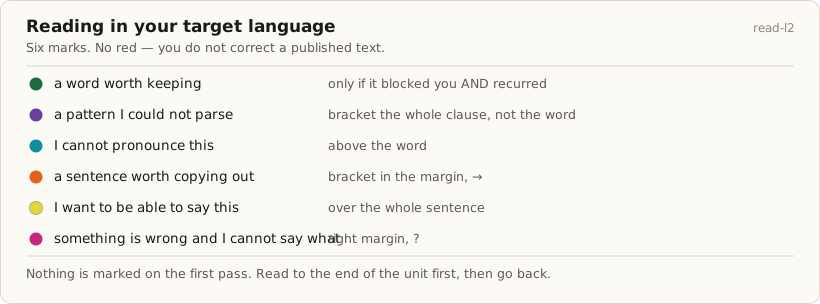
| Mark | Means | Applies to |
|---|---|---|
| green | a word worth keeping | the word, boxed |
| purple | a pattern I could not parse | the whole clause, not the word |
| turquoise | I cannot pronounce this | above the word |
| orange | a sentence worth copying out | bracket in the margin |
| yellow | I want to be able to say this | the whole sentence |
| magenta | something is wrong and I cannot name it | right margin |
The one rule
Nothing is marked on the first pass. You read to the end of the unit — a paragraph, a page, a chapter, whatever you set out to finish — and only then go back. This is the whole discipline, and almost every failure of highlighting traces back to breaking it.
The reason is that on the first pass you cannot yet tell what mattered. A word that stops you in line two often turns out to be explained in line six, or to be irrelevant, or to recur four more times and become obvious. Marking it immediately freezes a judgement you were not yet in a position to make, and it interrupts the run of comprehension that was doing the actual teaching. The second pass costs a fraction of the time and produces marks you still agree with a week later.
The corollary is that a text you cannot finish a unit of is a text you should not be annotating. If you cannot get through a paragraph without stopping, the problem is the level, not the pen.
Should this be highlighted?
Most highlighting fails not because the wrong colour was used but because too much was marked, and too much was marked because there was no test. Three questions, run in order, in about two seconds each.
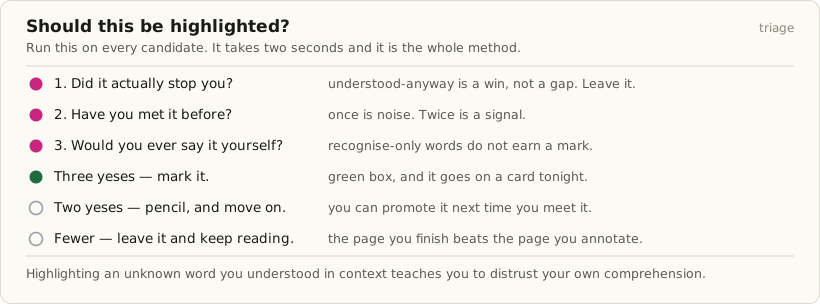
- Did it actually stop you? Not was it unknown — was it an obstacle. A word you did not know and understood anyway is the single best thing that can happen while reading, and marking it teaches you to distrust the inference that just worked.
- Have you met it before? Once is noise. A word you have now seen twice is telling you something about its frequency that no list can.
- Would you ever say it yourself? Plenty of vocabulary is worth recognising and not worth producing. Recognition arrives free with volume; a mark is a claim on your evening.
Three yeses earns a green box and a card the same night. Two earns a pencil mark, which you can promote the next time the word appears — the second encounter is a better judge than the first. Fewer than two and you leave it and keep reading, because the page you finish beats the page you annotate.
How much to mark
The numbers below are ceilings rather than targets, and exceeding one is information about the text rather than about you.
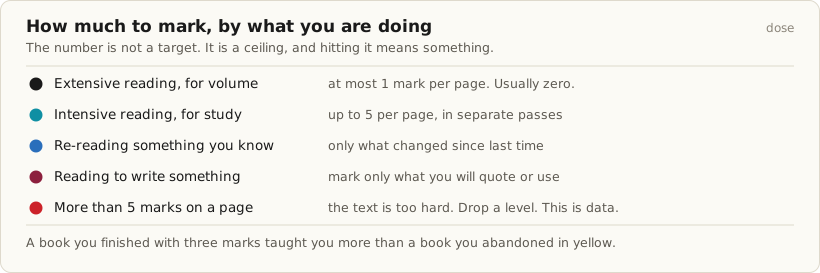
Extensive reading — the kind you do for volume, in the target language, for pleasure — should be nearly clean. At most one mark a page and usually none. The gain in extensive reading comes from the quantity of comprehensible text you move through, and every stop is a tax on that. If you are marking three or four things a page you are not reading extensively any more, whatever the intention was.
Intensive reading is the opposite mode and tolerates up to about five marks a page, applied in separate passes rather than all at once: meaning first, then pattern, then sound. Passing over the same page three times with one pen each is faster than switching pens every line, and the marks come out cleaner.
Crossing five is worth treating as data. It reliably means the text is above the level where either mode works, and the useful response is to drop a level rather than to push through in yellow. A book finished with three marks has taught more than a book abandoned at chapter two under a wash of highlighter.
Reading in a language you already speak
This is a different activity that happens to use the same pens. You are not collecting vocabulary, so the green layer stops meaning a word you are learning and starts meaning a term of art — the author's own coinage or specialist usage, which you box and then define in your own words somewhere else. What replaces the vocabulary work is argument structure.
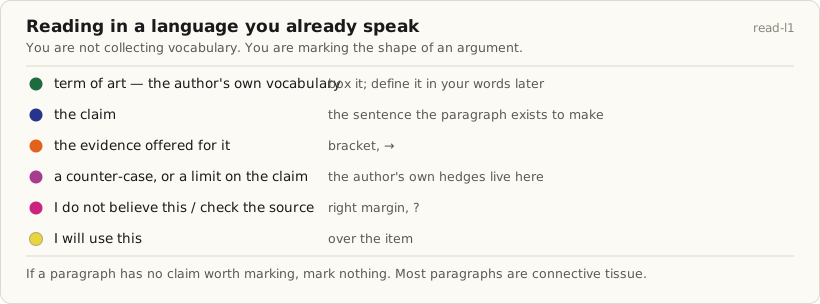
Blue marks the claim: the one sentence a paragraph exists to make. Orange marks the evidence offered for it, which is often in a different paragraph and sometimes absent, and noticing the absence is the reason to mark at all. Violet marks a counter-case or a limit — the author's own hedges live here, and they are the part most readers skim. Magenta means you do not believe it and intend to check.
The discipline that matters here is the willingness to leave a paragraph unmarked. Most prose is connective tissue, and a page with one blue mark and nothing else is usually a correctly read page.
When you cannot mark the page
Library books, borrowed books, and books you like too much to write in. Nothing about the system requires ownership; only the carrier changes.
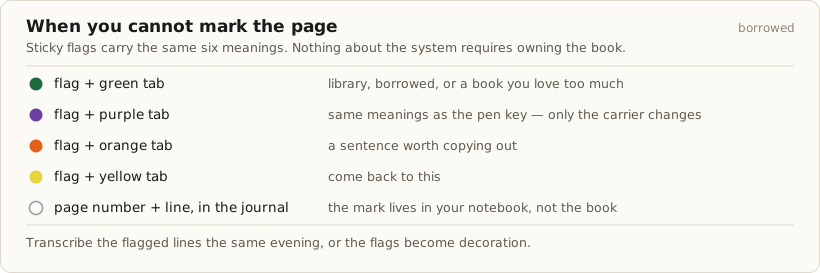
Coloured sticky flags map onto the same six meanings, with the page and line number written into the journal rather than the margin. The one hazard is that a flag defers the work rather than doing it, and a book bristling with tabs nobody transcribed is worse than a book read cleanly. Transcribe the same evening or accept that the flags were decoration.
What this claims, and what it does not
It does not claim that highlighting aids memory. The research on highlighting and underlining as students ordinarily practise them is not flattering — reviews of study techniques have repeatedly placed them among the least effective of the common strategies, well below retrieval practice and distributed practice. Nothing here contradicts that, and a system built on the premise that marking a word helps you remember it would be building on sand.
What the system claims is narrower and survives that finding. First, the selection decision is itself the work: running three questions over a candidate word forces a judgement about frequency, obstruction and productive value, and that judgement is generative in a way that a wash of yellow is not. Second, a mark is a pointer, not a memory aid — its whole job is to survive until the evening, when the marked item becomes a card, a sentence in the journal, or a question for a speaker. The learning happens there. Third, a ceiling on marks per page keeps extensive reading extensive, which is the one mechanism in this document with genuinely strong support behind it.
If you mark five things a page and transcribe none of them, this system has done nothing for you, and it will not start working if you buy better pens.
The two-week trial
Read as you normally would for two weeks, with one change: apply nothing on the first pass. Do not adopt the colours yet. Most of the available benefit is in that single rule, and separating it from the colour system tells you which part is actually helping.
From week three, add green and magenta only — the word worth keeping, and the thing you cannot name. Two pens, two meanings. Add a third colour only after you catch yourself wanting a distinction the two cannot make. A role you never reach for is not a role you are keeping in reserve; it is a role to drop, and dropping it makes the remaining ones faster to select.
At the end of each week, count what you transcribed against what you marked. That ratio is the only honest measure of whether the system is working. Marks that never became cards or journal lines were interruptions with a colour.
Related
- LC Journal Color Coding — the composition-side key this one shares its colours with
- Extensive reading — the mode with the strongest case for marking almost nothing
- Comprehensible input — why an unknown word you understood anyway is a success
- Anki guide — where a green box is supposed to end up the same evening